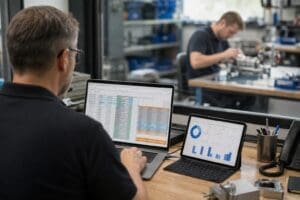

The world is fully operating in the digital environment; paperless manufacturing is the next step in pivoting your business into an efficient and robust operation. Have you considered whether an MRP software system is the solution your business needs?
Why go paperless?
A small business may spend over £14k a year on printing and traditional filing, the cost triples when considering a large manufacturing facility. By replacing paper, it significantly cuts down on costs across various departments, including operation and supply costs.
Paper is replaced by a cloud-based manufacturing software that acts as a central information hub that can provide real-time data that tracks work orders, customer orders, and purchase orders. All orders are managed and coordinated digitally while reporting production activities are easily accessible through the digital platform.
Common Misconceptions About Going Paperless
“It has to happen all at once.” Going paperless can happen at your own pace. Even with unlimited time and resources, a staged approach still makes sense, starting with office processes before moving out to the shop floor. There’s no need to convert everything on day one.
“We’ll lose access to engineering drawings and technical specs.” This is a common worry, and understandably so, paper drawings are simple to manage day to day. But that simplicity comes with a real risk. It’s not unusual for the wrong version of a drawing to end up in use because the most recent one was misplaced or accidentally destroyed. Attaching drawings and technical documents directly to the digital job removes that risk, since whoever is working the job always has the current version to hand.
4 Benefits of Having a Paperless Facility
Eliminate non-value-added tasks
Gone are the days of manually filing paper files. An MRP Software can clearly show the production requirements, supplies in stock, and which supplies have been ordered. This avoids duplicating goods production. This will help your business save money in the long term and reduce waste. Customers can benefit from this system as it displays production information for managers to streamline their orders. Instead of manually rekeying data, smart workflows allow workers to track items quickly, making the process efficient and speedy. When departments can have instant access to real-time data, there won’t be a need to manually handle stacks of paper to create reports. An MRP software can streamline all of that for you.
Better traceability
Without MRP Software, manufacturers can run the risk of delays and lost information when important data are scattered in physical paper copies if not organised properly. Important and time-sensitive information adds stress to your operations and can be costly. Data stored in the cloud-based software are easily accessible, especially if your business operates in various locations. The software can also track stock so you can drive production demand based on customer orders. Digitising your manufacturing process saves more time that can be used to increase customer satisfaction, and increase output and value.
Paper-based records cause problems in a few consistent ways.
The most basic is simply finding the right piece of paper. When a problem arises with a product made some time ago, the records are often filed away in a folder in a cupboard at the back of the factory, and locating the right one can take far longer than it should.
A more serious version of this is when the paperwork was never filed correctly in the first place, for example a QC form that never actually got attached to the job sheet before everything was put away.
Handwriting causes its own problems. A reading scribbled down from a test or measurement can be illegible, and paper has no way to catch an entry that’s out of range or simply wrong. A digital record removes the legibility issue entirely, and can also validate that a reading makes sense before it’s accepted.
Serial and batch number tracking is another area that suffers on paper. Recorded by hand, it’s disconnected from actual stock levels and difficult to interrogate if a problem needs tracing back to a specific batch or component. Captured digitally, the same information is linked in real time to stock, and can be searched and traced instantly.
Perhaps the most common scenario manufacturers describe is the scramble before an ISO or customer audit, pulling together folders and paperwork to prove records are complete, a process that can take days of preparation. When records are already digital and complete as a matter of course, that scramble simply doesn’t happen.
Shorter lead time
A manufacturer’s value and success comes from reducing lead times as much as possible. A built-in CRM system allows workers to react quickly to customer orders using MRP software. The real-time instant data showing supplies in stock and production helps the software calculate accurate lead time and determines production costs in seconds. The software can shorten lead time by speeding up planning, routing, purchasing, production scheduling, and production planning and control steps. In a fast-paced manufacturing environment, time is of the essence, and MRP software can benefit an organisation focused on reducing lead time.
Better for the Environment
Trees act as a natural carbon sink that sequesters carbon from the atmosphere. As the forest matures, the remaining trees continue to grow and sequester more carbon. In 2020, paper and board consumption in the United Kingdom amounted to 9.9 million metric tons, and it takes 24 trees to make one ton of paper! Keeping trees in the forest is better for the environment to meet the UK’s Net-Zero emissions target by 2050 and can benefit your organisation if your goal is to reduce greenhouse gas emissions. Going paperless also saves money for your business, minimising energy use and fuel to transport and print paper products.
Where Should You Start With Going Paperless?
A paperless transition typically takes anywhere from four weeks to several months, depending on the size of the business and how much capacity there is to dedicate to it.
The simplest place to start is stock and goods inwards. Instead of scribbling details on a paper docket, checking goods in and booking them into stock can be done directly on screen, improving accuracy and removing the paper trail of passing a docket to the office (hoping it doesn’t get lost along the way) and manually checking it against a supplier invoice later.
From there, a typical order follows the office first: parts, stock, products and bills of materials, then purchase orders and production job cards. Only after that does the process move out to the shop floor, covering resource-specific work instructions, time tracking (another area that becomes hard to pin down accurately on paper), access to drawings and technical documents, and finally QC data capture.
How long does it take to go paperless in manufacturing? Typically four weeks to several months, depending on the size of the business and how much time can be dedicated to the transition. Most manufacturers start with office processes like stock and goods inwards before moving on to the shop floor.
There’s no better time than right now to implement an MRP system. Book a demo of Flowlens today and get some free expert advice!