If you’re an SME equipment manufacturer and an ERP salesperson has just quoted you £60,000 for a system you’re not sure you need, this post is the second opinion. The MRP-or-ERP question is the single most common one that lands on Flowlens’ discovery calls, and most of the content out there is written by ERP vendors who have a reason to push you toward the heavier option. The honest answer is narrower, more practical, and almost always saves money.
This is for MDs, Operations Directors, and Finance Directors at 15-75 person SME equipment, device, and machinery manufacturers — already on Xero, QuickBooks, or Sage 50 for accounts — who have been told they need an ERP and want to know whether that’s actually true.
In brief: MRP (Material Requirements Planning) is a subset of what ERP (Enterprise Resource Planning) covers. For the vast majority of SME equipment manufacturers, the MRP subset is enough, and buying a full ERP they won’t use is the most expensive mistake in small-business software. The third option most ERP vendors won’t mention — a specialist MRP that integrates with your existing accounts package — is usually the right answer.
Flowlens is one example built specifically for SME equipment, device, and machinery manufacturers in the discrete manufacturing space.
The honest short answer
MRP is a subset of what ERP does. Most manufacturing ERPs have an MRP module included. The question isn’t really “MRP or ERP” — it’s “how much of the ERP beyond MRP do you actually need”. For most SME equipment manufacturers between 10 and 100 people, the answer is very little — and a full ERP implementation, with all its HR, advanced procurement, and CRM modules, will drown the business in complexity it can’t absorb.
That’s a strong position. Here’s why it’s the right one for the discrete manufacturing companies that Flowlens works with.
What MRP actually does
Material Requirements Planning, at its core, answers four questions: what do we need to make, what does it take to build, what have we got, and what do we need to buy. In practice that translates into:
- Bills of materials — multi-level, with sub-assemblies and sub-contracted operations, under revision control
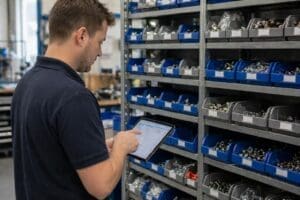
- Stock management — on-shelf, assigned-to-job, in-transit, with batch and serial number tracking
- Production planning — job cards, production routes, capacity against labour and machine hours
- Procurement — purchase orders, supplier performance, lead time integration, reorder point automation
That’s the engine of a manufacturing business. Get those four right and most of the daily operational pain goes away. Get them wrong and no amount of financial sophistication elsewhere will compensate.
What ERP adds on top
An ERP layers additional modules over the MRP engine: finance (general ledger, AP/AR, fixed assets), HR and payroll, advanced procurement with multi-entity approvals, CRM beyond basic sales pipeline, warehouse management for multi-site distribution, advanced supply chain planning, and often industry-specific modules for things like project accounting or field service.
Each of those is genuinely useful to a large business running at enterprise scale across multiple sites, legal entities, and countries. A 40-person SME manufacturer in Belfast or Cheshire doesn’t need multi-entity procurement approvals. They need reliable stock, accurate BOMs, and a clean handoff to the accounts package they already use.
The “buying an ERP you won’t use” trap
The most expensive mistake in SME manufacturing software is buying capability that never gets used. A full ERP implementation for a 40-person manufacturer often ends the same way: twelve months in, five of the modules are configured but unused, the finance team still runs a shadow spreadsheet because the ERP’s workflow is too heavy for their invoice volume, the ops team have customised three modules into paralysis trying to make them fit, and the annual licence bill is £40,000 more than it needs to be.
This happens because ERP vendors are incentivised to sell the whole platform. It also happens because ERP salespeople talk to MDs and FDs, not to the people who have to operate the thing on the ground afterwards. A good evaluation starts with the question “what do we actually do every day” — not “what does this platform do that looks impressive in a demo”.
As Rich Dale, founder of Flowlens, puts it: the vendor relationship matters as much as the feature list. Will the vendor understand the shape of an SME equipment manufacturer’s business? Will their roadmap be relevant to you in three years, or are you a small fish in a platform designed for much larger customers? Those questions decide whether the implementation lives or dies — more reliably than any feature comparison.
The third option most ERP vendors won’t mention
There’s a third category of tool that rarely shows up in “ERP vs MRP” articles because the ERP vendors writing them have no interest in telling you about it: a specialist MRP built for your sector that integrates with the accounts package you already have.
Under this approach:
- Your accounts stay in Xero, QuickBooks, or Sage 50, where your accountant is comfortable and the monthly cycle already works
- A manufacturing-specific MRP handles BOMs, stock, production, procurement, and often CRM and service as well
- Sales orders, purchase orders, stock valuations, and invoices pass between the two systems cleanly, with no rekeying and no duplication
- You pay for the manufacturing capability you actually use, and nothing else
Julian, MD of distributor Halomec, went through this evaluation end-to-end. He engaged an external consultant, started with eight vendor options, and narrowed it to three before choosing Flowlens as the best fit for his equipment business.
“It was really important that we had everybody, all the stakeholders bought in on it,” he explained. The stakeholder buy-in was as much about fit as about features — an ERP that nobody used would have been wasted money regardless of its capability.
Where Flowlens sits — honestly
Flowlens is a cloud MRP + MES + CRM + Service platform built specifically for SME equipment, device, and machinery manufacturers of 1-100 people in discrete manufacturing, particularly those with quality accreditation (or aspirations) such as ISO:9001. That includes sensor makers, wiring harness assemblers, subsea equipment builders, LED lighting, water treatment kit, switchgear, and similar businesses.
Flowlens is not the right answer for food manufacturers, chemical or other process manufacturers, pharma compounding, or fast-moving consumer goods operations with 10,000-plus SKUs. It’s not the right answer for a 500-person multi-site organisation with multiple legal entities and complex project-accounting needs. If you’re that business, a full ERP is genuinely where you need to be.
Most SMEs aren’t those businesses. They’re discrete equipment and device manufacturers of 15-100 people, and they need MRP done well with a clean accounts integration — which is exactly what Flowlens builds.
What to ask on a demo call
Whether you’re evaluating Flowlens or any other vendor, the demo call questions that tell you most are operational, not technical:
- Show me how a sales order turns into a production order turns into a stock commitment — without anyone typing the same thing twice
- Show me multi-level BOMs with a sub-assembly change cascading upward
- Show me how this integrates with my existing accounts package — what flows, what doesn’t, what reconciles monthly
- Who implements this — your team, a partner, or are we figuring it out ourselves
- What’s the monthly cost in year one, year two, and year five, including users we haven’t hired yet
Answers that start with “we can do that, it’s a custom development” are a yellow flag. Answers that start with “it’s there out of the box, here’s how” are green.
Conclusion
MRP or ERP is the wrong framing for most SME equipment manufacturers. The real question is whether you need the manufacturing subset of an ERP, which you almost certainly do, and whether you need the rest of the ERP on top, which you almost certainly don’t. A specialist MRP that suits your style of manufacturing and integrates with your existing Xero, QuickBooks, or Sage 50 is usually the honest answer — and it’s available at a fraction of what a full ERP costs to implement and run.
FAQs
Is MRP the same as ERP?
No. MRP (Material Requirements Planning) is the manufacturing engine — BOMs, stock, production, procurement. ERP (Enterprise Resource Planning) layers finance, HR, multi-entity procurement, and other modules on top of that engine. Every ERP has an MRP module; most SME equipment manufacturers only need the MRP part.
Will an MRP replace our accounts package?
A specialist MRP for SME manufacturers shouldn’t replace your accounts package — it should integrate with it. Flowlens integrates directly with Xero, QuickBooks, and Sage 50, which means finance stays where your accountant is comfortable and the manufacturing system handles stock, BOMs, and production.
When does an SME manufacturer genuinely need a full ERP?
Typically when you’ve grown to several hundred staff, operate across multiple legal entities or countries, have project-accounting or multi-site warehouse needs, or work in regulated process manufacturing (food, pharma, chemicals). Below that, an SME-focused MRP plus your existing accounts package is both cheaper and more likely to get adopted.
Want to talk through whether an MRP or an ERP makes sense for your business specifically? Book a discovery call with Flowlens — an honest, no-obligation conversation with someone who’ll tell you if we’re not the right fit.